Why Growing Businesses Are Skipping NetSuite — And What They’re Choosing Instead

You’ve outgrown QuickBooks. Everyone tells you the next step is NetSuite. But what if that’s not actually true? More and more growing businesses are discovering there’s a smarter path — one that gets them fully up and running in weeks, not months, without the enterprise price tag or the army of consultants.
Here’s what they’re choosing instead, and why.
The Assumption Nobody Questions
When a business outgrows QuickBooks, there’s a script everyone follows. Your accountant mentions NetSuite. Your software vendor mentions SAP or Microsoft Dynamics. The consultants you call mention Sage or Acumatica. It’s become the default answer so often that most businesses never stop to ask whether any of them are actually the right one.
It isn’t — for most growing businesses.
On one side, you have tools like QuickBooks. Simple, affordable, familiar. Great for getting started. But as your business grows, you start to feel the seams. You’re running reports in spreadsheets because QuickBooks can’t give you what you need. Your inventory is tracked in one system, your orders in another, your CRM somewhere else entirely. Nothing talks to anything. Your team spends hours every week reconciling data that should just… sync.
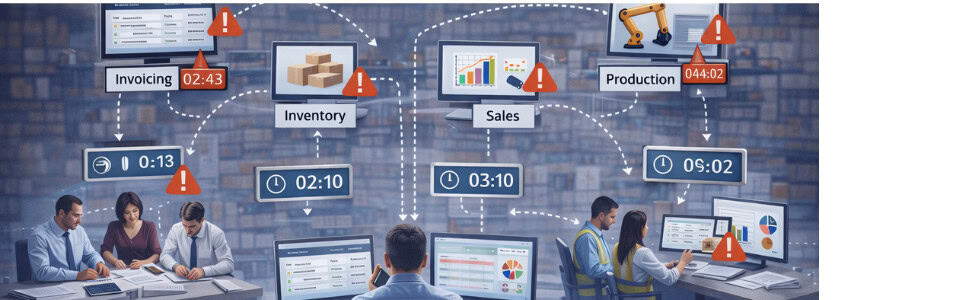
On the other side, you have NetSuite, SAP, Microsoft Dynamics. Powerful? Absolutely. But there’s a catch most vendors don’t mention upfront: these systems aren’t really software you buy — they’re systems you build. Out of the box, NetSuite is largely a foundation. Your actual business processes, workflows, and reports have to be designed, configured, and customized by consultants — often over 12 to 18 months, often at a cost that rivals a full-time hire. You’re not buying a running car. You’re buying a kit.
For a 50-person manufacturer or a fast-growing distributor, that’s not a solution. That’s a project.
The good news: there’s a better option — one that gives you everything you need to run and grow your business, fully integrated and ready to go from day one. Not a stepping stone. Not a compromise. The right answer for where your business is and where it’s going.
Signs You’ve Outgrown QuickBooks
QuickBooks is an excellent accounting tool. But it was designed to manage your books — not run your entire business. Here are the telltale signs that you’ve hit its ceiling:
Your data lives in too many places. You’ve got QuickBooks for accounting, a separate system for inventory, spreadsheets for orders, maybe a standalone CRM. Every report requires pulling data from multiple sources and praying nothing is out of sync.
You can’t see your business in real time. When your CEO asks “how are we tracking against last quarter?”, the honest answer is “I’ll have that for you by tomorrow.” Real-time visibility into inventory levels, order status, production, and cash flow just isn’t possible when your data is fragmented.
Your team is doing work that software should be doing. Manual data entry between systems. Copy-pasting orders from your e-commerce platform into your inventory system. Emailing purchase orders as PDFs. If this sounds familiar, you’re paying people to do what automation should handle.
You’re making decisions based on yesterday’s data. In fast-moving industries like manufacturing, distribution, and food services, lag time in your data can mean stockouts, missed shipments, or margin problems you don’t catch until it’s too late.
Closing the month takes forever. If your accounting team needs two to three weeks to close the books because data reconciliation is a manual nightmare, that’s a QuickBooks problem — not a people problem.
You can’t track a single order end to end. From purchase order to receipt to production to shipment to invoice — if you can’t see that entire journey in one place, your operations are flying partially blind.
If two or more of these sound familiar, you’ve outgrown QuickBooks. The question is: what comes next?
Why Most Growing Businesses Hesitate on ERP
Here’s the honest truth about why so many companies stay on QuickBooks too long: the horror stories.
Everyone has heard about the company that spent $500,000 implementing an ERP and didn’t go live for 18 months. Or the business that bought NetSuite, only to discover that “buying” was really just the beginning — because every workflow, every report, every process had to be built from scratch by a team of implementation consultants. Or the manufacturer who went live on a new system and watched their operations grind to a halt during the transition.
These stories are real. And they share a common thread: the vendor sold a platform, not a solution.
The reality of enterprise ERP is that the software itself is often just the starting point. NetSuite, for example, is a powerful development foundation — but your actual business processes don’t come pre-built. You’re paying consultants to construct the system your business needs, on top of a foundation you also paid for. More complexity means more consulting hours, more customization fees, more ongoing support contracts. For many growing businesses, that equation simply doesn’t add up.
This is why “we’ll just wait until we’re bigger” becomes the default strategy. But waiting has its own cost — in inefficiency, in manual labor, in decisions made on incomplete information, in growth that’s slower than it should be.
What a Mid-Market ERP Should Actually Look Like
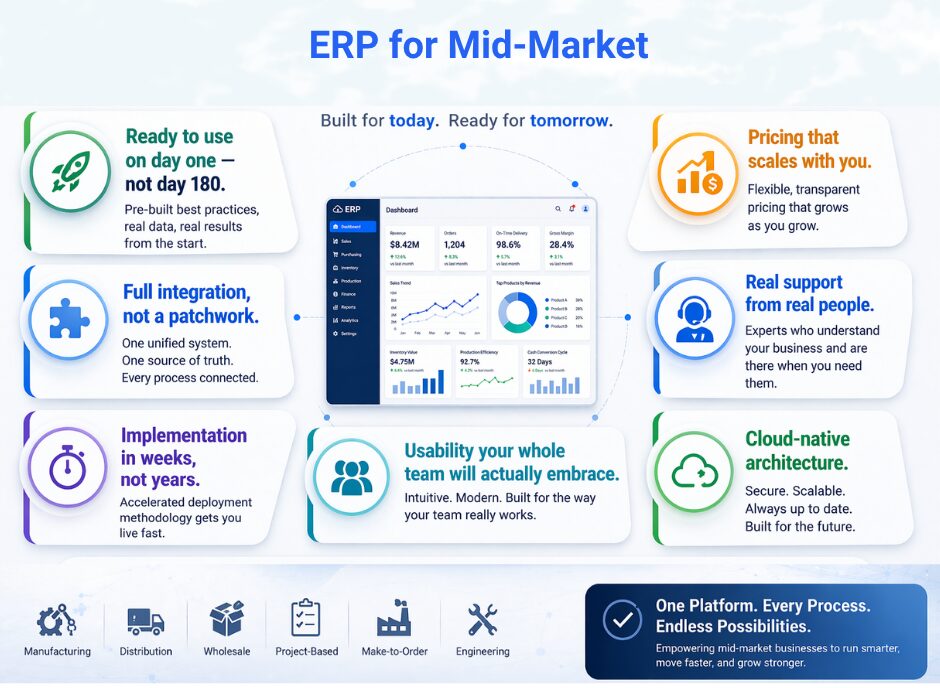
The right ERP for a growing business looks very different from what the enterprise vendors are selling. Here’s what actually matters:
Ready to use on day one — not day 180. There’s a massive difference between a platform and a solution. A platform gives you the tools to build what you need. A solution gives you what you need, already built. The right mid-market ERP should come with your core business processes pre-configured and hundreds of reports ready to run from day one — not a blank canvas that requires months of consulting to become useful.
Full integration, not a patchwork. The whole point of an ERP is that it’s one system. Finance, inventory, orders, procurement, manufacturing, CRM — all connected, all sharing data in real time. If you’re evaluating a system and it requires integrations or middleware to connect its own modules, that’s a red flag.
Implementation in weeks, not years. A system that takes 12–18 months to implement isn’t a business tool — it’s a project. Growing businesses need to be up and running in weeks, with a team that holds your hand through the process.
Usability your whole team will actually embrace. The best ERP in the world is worthless if your team won’t use it. Adoption is everything. The system needs to be intuitive enough that your warehouse manager, your sales team, and your controller can all use it without weeks of training.
Pricing that scales with you. You shouldn’t have to pay enterprise prices until you’re an enterprise. The right mid-market ERP charges based on what you actually use, and grows with you as your needs evolve.
Real support from real people. When something goes wrong — or when you’re trying to figure out how to configure a workflow — you need a support team that picks up the phone. Not a ticketing system with a 48-hour SLA.
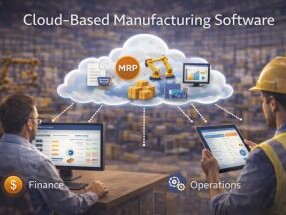
Cloud-native architecture. Your ERP should work from anywhere, on any device, without requiring on-site servers or an IT team to maintain it. The pandemic proved that businesses need the flexibility to operate remotely — your software should make that easy, not hard.
How Kechie Bridges the Gap
Kechie ERP was built specifically for growing businesses in manufacturing, distribution, healthcare, food services, and beyond — companies that have outgrown their starter tools but don’t need (or want) the complexity and cost of enterprise software.
Here’s what makes Kechie different:
Ready to go on day one. This is the most important difference between Kechie and solutions like NetSuite: Kechie isn’t something you build — it’s something you use. Every core business process comes pre-configured out of the box. Inventory management, order workflows, procurement approvals, financial reporting — it’s all there, working, from the moment you go live. There are hundreds of pre-built reports ready to run immediately, covering every corner of your business. You’re not paying consultants to construct your ERP. You’re up and running in weeks.
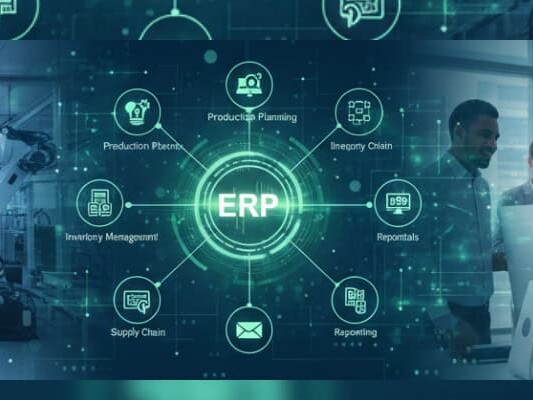
One fully integrated system. Kechie connects inventory management, order management, procurement, manufacturing, financial management, CRM, supply chain, and warehouse management in a single cloud-based system. There’s no middleware required. No data silos. When an order comes in, it flows automatically through inventory, fulfillment, and accounting — without anyone touching a keyboard to make it happen.
Live in weeks, not months. Because Kechie’s processes and reports come pre-built, implementation is about configuring your specifics — your products, your workflows, your team — not constructing the system from scratch. Most Kechie customers are fully live and running in weeks, supported by an implementation team that works alongside them the whole way.
Designed for real people. Kechie consistently earns “Best Ease of Use” recognition from Capterra — not because it’s missing features, but because it’s designed so that your whole team can actually use it. Complex doesn’t have to mean complicated.
AI-powered intelligence. Kechie’s AI-driven inventory optimization adjusts stock levels intelligently based on demand patterns, seasonality, and lead times — so you never run out of your best-selling SKUs and never over-invest in slow-moving inventory.
Configurable to your business. Unlike rigid enterprise systems, Kechie is built to flex around your workflows. Whether you’re running a 3PL operation, a nonprofit with unique procurement needs, or a medical device manufacturer navigating HIPAA compliance, Kechie can be configured to fit how you actually work.
Award-winning customer support. Kechie has won multiple awards for customer support — including recognition from Software Advice and SoftwareSuggest — because the team genuinely treats customers as partners. When you call, a real person answers.
Real Results from Real Companies
The proof isn’t in the features list — it’s in what happens when growing businesses actually implement Kechie.
Meals on Wheels San Francisco uses Kechie to manage the logistics of producing up to 30,000 meals daily for homebound seniors. The ability to track end-to-end supply chain — from procurement to inventory to the final delivery — transformed their operational capacity.
Distribution companies using Kechie report completing two to three times more work with the same headcount, simply because manual processes have been replaced with automated workflows. That’s not a small improvement — that’s a business transformation.
Organizations across industries consistently report 30% reductions in overhead costs after implementing Kechie, driven by the elimination of redundant systems, manual data entry, and inefficient processes.
The True Cost of Waiting
Here’s the math that most businesses don’t run: what does staying on QuickBooks actually cost?
If your team spends 10 hours a week on manual data reconciliation between disconnected systems, that’s 520 hours a year. At $40/hour fully loaded, that’s $20,800 in pure labor cost — every year — just to compensate for software that doesn’t talk to itself.
Add in the cost of stockouts (lost sales, expedited shipping, customer churn), the cost of decisions made on stale data, and the cost of a finance team that spends three weeks closing the month instead of one — and the picture gets expensive fast.
The question isn’t whether you can afford to upgrade your systems. It’s whether you can afford to wait.
Is Kechie Right for Your Business?
Kechie is a great fit if:
- You’re a manufacturer, distributor, or product-based business with 10 to 500 employees
- You’re currently running on QuickBooks (or multiple disconnected systems) and feeling the limits
- You need full ERP functionality — inventory, orders, finance, manufacturing, CRM — in one integrated system
- You want a system your whole team will actually use, without months of training
- You value responsive, human support over impersonal ticketing systems
- You’re looking for enterprise-level capability without the enterprise price tag or implementation timeline
Kechie may not be the right fit if you’re a very early-stage startup with simple needs — QuickBooks may genuinely be enough for now. Or if you’re a $500M enterprise with highly complex, custom-built workflows that require a full implementation team. There’s no shame in knowing where a product fits.
But if you’re in that middle ground — a growing business that’s outgrown your current tools and is looking for a real solution that won’t take over your life or your budget — Kechie is worth a serious look.
What to Expect From a Kechie Demo
A Kechie demo isn’t a canned slide deck. It’s a working session where the team walks through your specific business challenges and shows you, concretely, how Kechie handles them.
You’ll see the actual interface your team would use. You’ll understand the implementation timeline and what support looks like from day one. And you’ll get a clear sense of whether Kechie is genuinely the right fit — or whether something else might serve you better.
No pressure. No hard sell. Just an honest conversation about whether this is the right path for your business.
Ready to Find Out?
If you’re nodding along to any of this — if the QuickBooks limitations sound familiar, if the enterprise ERP horror stories give you pause, if you’re ready to run your business from one place instead of five — the next step is simple.
Book a free demo with the Kechie team ➤ www.myofficeapps.com/free-demo/
See Kechie in action. Ask the hard questions. Find out what implementation actually looks like for a business like yours.
The gap between where you are and where you want to be is smaller than you think.
________________________________________
Kechie ERP by My Office Apps — Forbes Top 10 ERP System of 2025. Trusted by growing businesses in manufacturing, distribution, healthcare, food services, nonprofits, and more.
Schedule a Free Demo Today!
See how Kechie ERP can transform your business, save you time, money, and aggravation. Click the button below to schedule your free demo.
Schedule Your Kechie Demo Now!In This Article
In This Article
-The Assumption Nobody Questions
-Signs You”ve Outgrown QuickBooks
-Why Most Growing Businesses Hesitate on ERP
-What a Mid-Market ERP Should Actually Look Like
-How Kechie Bridges the Gap
-Real Results from Real Companies
-The True Cost of Waiting
-Is Kechie Right for Your Business?